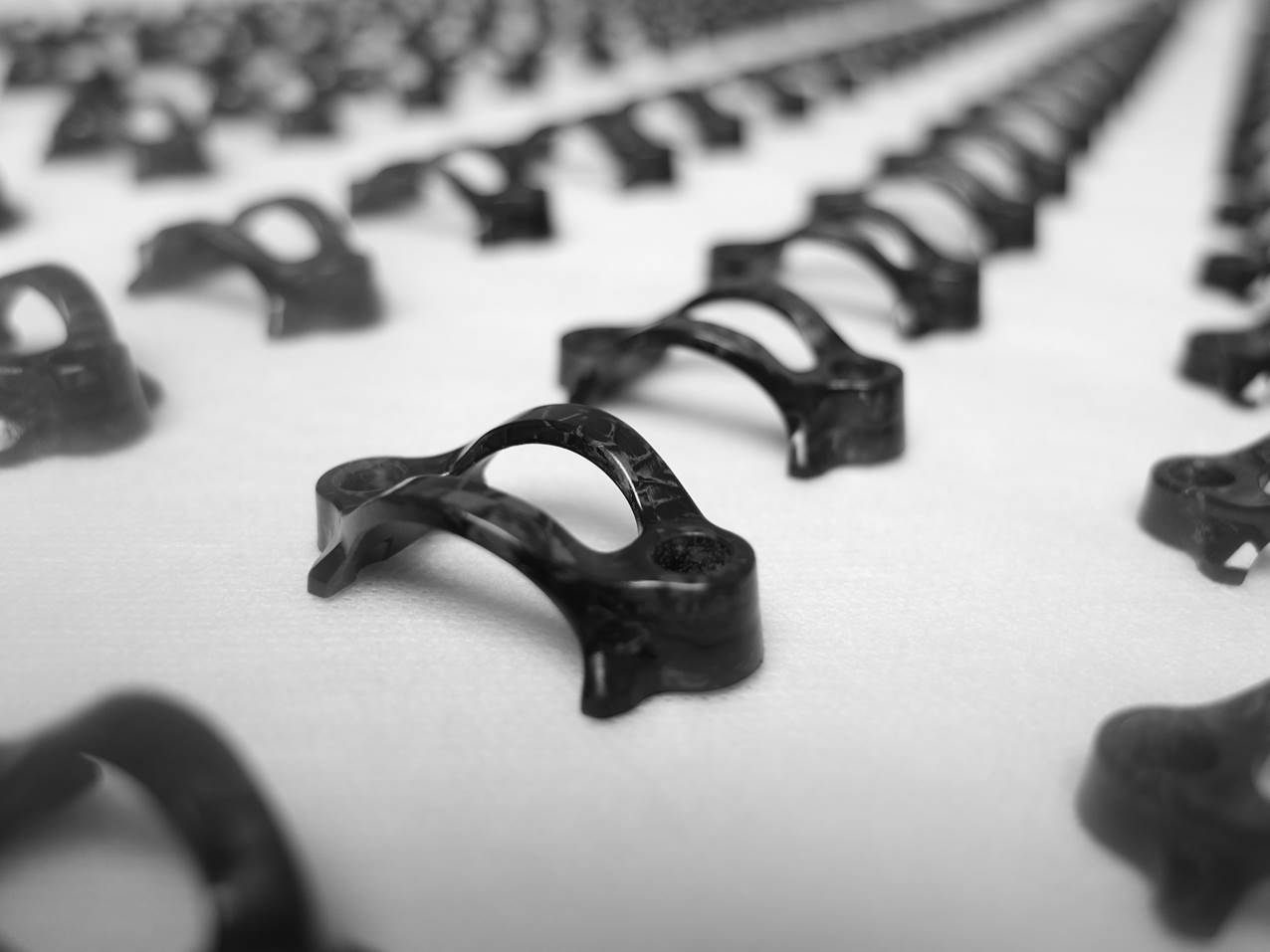
Two Process Chains, One Strategic Question
Anyone developing composite components for industrial series production will sooner or later face the same question: Prepreg autoclave or Tailored Fiber Placement combined with Resin Transfer Molding? Both methods produce high-quality fiber-reinforced plastic components. Both have their merits. Yet, they differ fundamentally in their suitability for reproducible, scalable, and cost-efficient production.
BIONTEC has deliberately and fully specialized in the combination of Tailored Fiber Placement (TFP) and Resin Transfer Molding (RTM). This article explains why and what this decision means for your components.
The Prepreg Autoclave Process: Proven, but With Clear Limitations
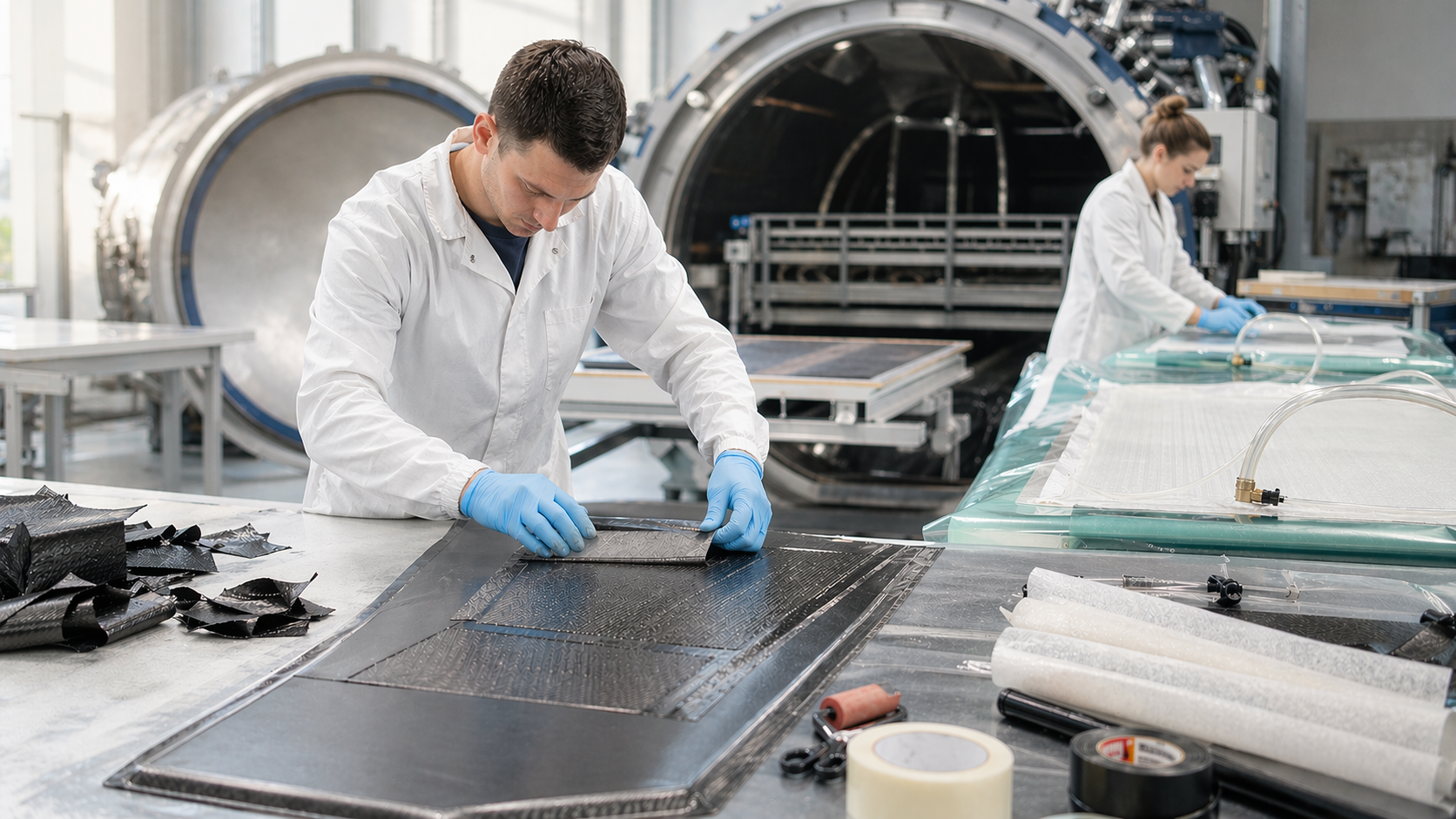
The prepreg autoclave process has a long history of success, particularly in aerospace. Pre-impregnated fiber semi-finished products (prepregs) are manually or semi-automatically built up into a laminate, enclosed in a vacuum bag, and cured in an autoclave under pressure and temperature. The result can be very high-quality if the process and personnel are right.
The problem: That's precisely where the crux lies. The manual effort for lay-up and vacuum bagging is high. Quality depends on process discipline. Prepregs must be stored frozen, have limited processing times, and require a variety of auxiliary materials for each cycle. The autoclave itself is energy-intensive and limits capacity.
What makes the process stand out:
- High laminate quality with carefully executed lay-up
- High design freedom in laminate architecture
- Established qualification paths in certain industries
Where it reaches its limits:
- High manual effort, difficult to scale
- Cost-intensive cold chain for storage and transport
- High consumption of auxiliary materials per cycle (vacuum film, peel ply, sealant tape)
- Significant material waste during ply cutting
- Energy-intensive curing process under pressure and temperature
- Limited automation potential with increasing production volumes
The more ambitious the cost targets and the higher the required production volumes, the more apparent these weaknesses become.
Tailored Fiber Placement + Resin Transfer Molding: Series Production by Design
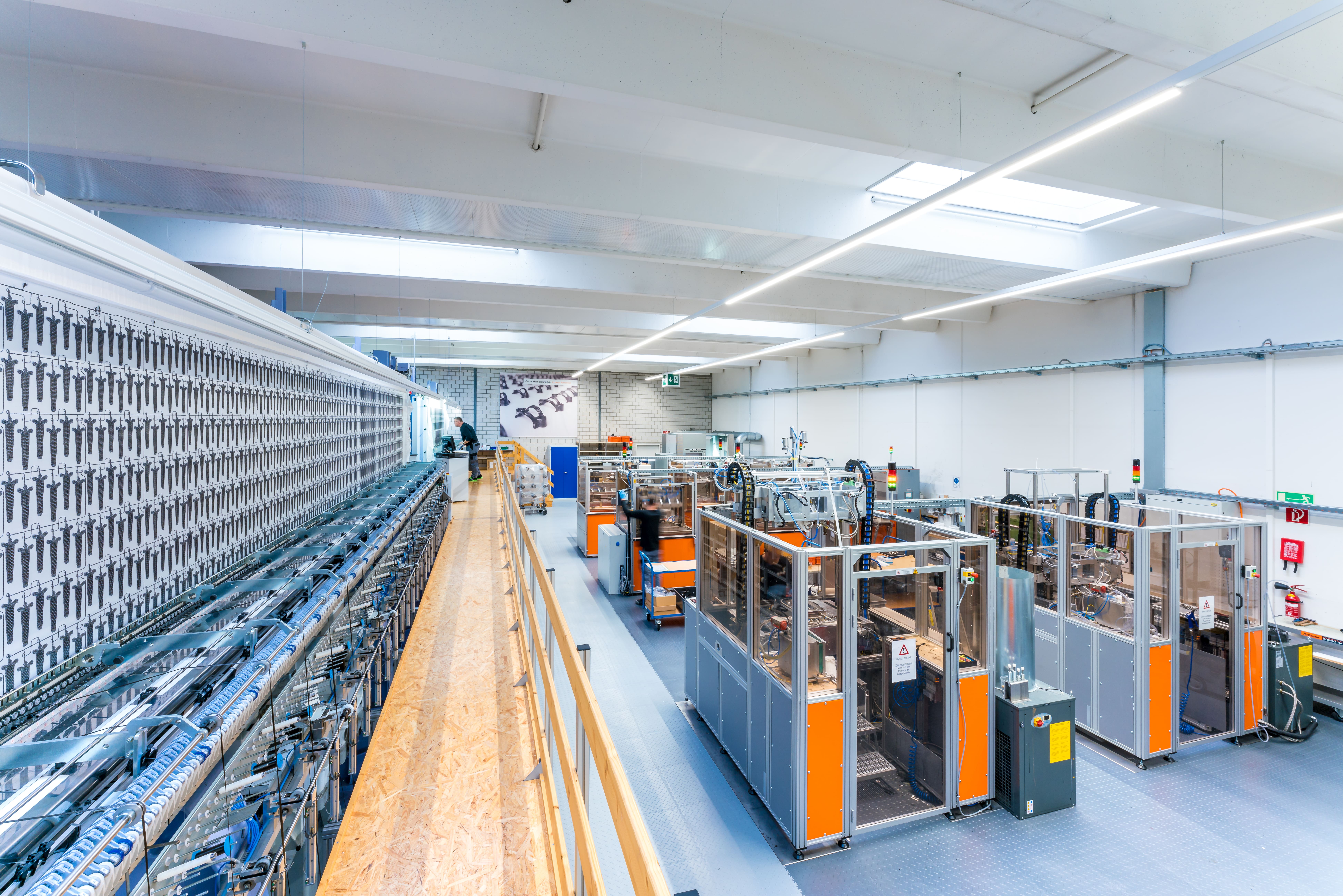
At BIONTEC, Tailored Fiber Placement and Resin Transfer Molding are not two isolated processes, but an integrated process chain. They complement each other to create a closed, scalable, and reproducible process: from fiber placement to the finished component.
Tailored Fiber Placement (TFP): Fibers Follow the Forces
Tailored Fiber Placement is a computer-controlled embroidery technology process: continuous fibers are precisely laid along defined load paths on a carrier material and fixed by a high-precision embroidery process. The result is a load-path-optimized fiber architecture that places material exactly where forces occur, and nowhere else.
What this means in practice: material waste is less than 2%, while conventional methods typically generate up to 30% scrap. This is not a marginal difference, but a different order of magnitude in material efficiency. Carbon fibers are expensive. Every gram unnecessarily consumed reduces the cost-effectiveness of the component.
At BIONTEC, TFP is being further developed as part of what is known as Bionic Fiber Placement: biological models serve as the basis for the fiber architecture. As in nature, material is specifically used where stresses occur. Structural calculation via FEM analysis determines the load paths, bionic optimization translates them into fiber paths, and the TFP machine implements them in a computer-controlled manner.
Resin Transfer Molding (RTM): Controlled Quality in a Closed System
Resin Transfer Molding is a closed manufacturing process: the dry TFP preform is placed into a two-part mold, the cavity is closed, and the resin system is injected under vacuum into the fiber structure in a controlled manner. After curing under defined conditions, the consolidated component is demolded.
The closed mold system makes the decisive difference: process control over material usage, fiber volume content, and component quality is reproducible. High-quality surfaces on both sides are created directly from the mold, without extensive post-processing. Air inclusions and porosities are largely eliminated by the vacuum environment and optimized venting.
Differences Explained on a Component
Before the two processes are compared in detail, the following graphic shows the key differences between TFP-RTM and the prepreg autoclave process using a real component. The effects on fiber architecture, material efficiency, surface quality, and other key advantages are directly visible here:

Detailed Comparison of the Processes
The following overview shows the essential differences between both process chains at a glance:
5 Reasons Why TFP & RTM Are Compelling
1. Fibers Are Not Cut and Thus Not Damaged
In conventional prepreg processes, carbon fabrics are cut. That sounds like a technical detail, but it has far-reaching consequences: when cutting, the fibers are severed. Exactly where a cut is made, the laminate loses strength. This becomes particularly critical at holes and cutouts: conventionally manufactured laminates are weakened in these areas because the fibers are interrupted.
Tailored Fiber Placement takes a fundamentally different approach. The fibers are not cut, but laid continuously and in a load-path-optimized manner. Holes are specifically embroidered around, with the fiber architecture following the local force introduction. The result is components that are structurally stronger, especially at the most critical points, than comparable laminates made from cut fabric.
2. Material Efficiency on Another Level
In the prepreg process, waste is inevitable: layers are cut, overlaps occur, and remnants remain. With Tailored Fiber Placement, however, fibers are deposited only where they are structurally needed. Waste is less than 2%, compared to up to 30% with conventional cutting methods.
For components made of carbon fiber reinforced plastics, which have significant material value, this difference makes a noticeable economic impact over the course of series production. TFP is therefore not only more ecologically sound but also economically superior.
3. Automation and Reproducibility
The classic prepreg process relies on skilled personnel. Layers are manually applied, positions are checked, and vacuum setups are prepared. This manual labor component is costly and introduces inherent quality variations.
Tailored Fiber Placement and Resin Transfer Molding, however, are designed for automation from the ground up. Fiber placement is computer-controlled, reproducible, traceable, and documentable. Resin infusion in the closed RTM mold occurs under defined, monitorable parameters. The result: consistent component quality across all production cycles.
For buyers and production planners, this means predictable cycle times, calculable unit costs, and quality assurance based on measurable process parameters, not on daily condition or manual dexterity.
4. Lower Operating and Energy Costs
Prepregs are sensitive: They must be stored frozen, have limited processing times, and require numerous disposable materials per cycle, such as vacuum films, peel plies, and sealing tapes. Additionally, long autoclave cycles with high pressure and elevated temperatures significantly increase energy consumption per batch.
RTM resin systems do not require a cold chain and use significantly fewer auxiliary materials, as injection takes place in a closed mold. At the same time, RTM molds are locally heated and allow for shorter cycles. This lowers operating costs, reduces logistical effort, and improves the manufacturing process's ecological footprint.
5. Scalability for Industrial Series Production
Here lies perhaps the most significant difference: The prepreg autoclave process reaches its natural limits with increasing production volumes. Cycle times can hardly be compressed, personnel effort can hardly be reduced, and the autoclave remains a bottleneck.
TFP + RTM is designed for series production. Automated fiber placement produces reproducible preforms. RTM molds are designed for thousands of cycles. The process chain can be scaled without costs increasing proportionally. This is exactly what industrial customers in mechanical engineering, robotics, medical technology, and aerospace need: a process chain that grows with their requirements.
When the Prepreg Autoclave Process is Still the Right Choice
Honesty is part of good consulting. The prepreg autoclave process has its merits, especially in the following situations:
- Prototypes and very small production volumes: If RTM tooling costs would be disproportionate, prepreg offers a more economical entry point.
- Maximum design freedom in laminate construction: For very complex laminate architectures, requiring full flexibility in layers and orientations, prepreg offers advantages.
- Existing qualification paths: Where regulatory approvals or customer specifications are specifically geared towards autoclave prepreg and re-qualification is to be avoided.
The decision between both processes always depends on the specific requirement profile: production volume, component complexity, quality requirements, timeframe, and economic objectives. BIONTEC analyzes these factors together with its customers, without offering pre-conceived solutions.
The BIONTEC Approach: Bionic Fiber Architecture Meets Industrial Series Production
BIONTEC has deliberately and fully specialized in the combination of Tailored Fiber Placement and Resin Transfer Molding. This decision stems from a clear conviction: modern series production demands processes that are scalable, energy-efficient, reproducible, and economically viable. The prepreg autoclave process cannot deliver this to the same extent as demands rise.
TFP allows bionic principles to be directly translated into the fiber architecture. As in nature, material is used precisely where forces occur. Load paths are calculated via FEM analysis, fiber orientations are translated into embroidery data, and implemented by computer control. RTM then ensures reproducible resin infusion in a closed mold, from small batches to economically viable large-scale production.
The result is composite components with an optimized strength-to-weight ratio, high-quality surfaces on both sides, and a process chain that can be scaled. From requirements analysis, FEM simulation, prototype development, and preform manufacturing to qualified series production, BIONTEC supports projects in mechanical engineering, robotics, medical technology, metrology, and aerospace.
Our Approach at a Glance:
- Material Selection: Based on specific load cases and requirements
- Simulation: FEM analysis to determine load paths and optimize fiber architecture
- Tailored Fiber Placement: Computer-controlled, bionically optimized fiber placement using embroidery technology
- Resin Transfer Molding: Controlled resin infusion in a closed mold for reproducible quality
- Scalable Production: From functional prototypes to economically viable series production
Conclusion: Process Selection as a Strategic Decision
The choice between prepreg autoclave and Tailored Fiber Placement in combination with Resin Transfer Molding is not purely a technical question. It is a decision about economic viability, scalability, and manufacturing philosophy.
Those who manufacture individual parts and prototypes with maximum design freedom will find a proven partner in the prepreg process. However, those who require reproducible series components with high material efficiency, shorter cycle times, and automatable processes cannot overlook TFP + RTM.
BIONTEC made this decision and develops customized solutions for clients from various industries that deliver exactly that: technically high-quality composite components that can be manufactured economically and reproducibly.
Do you have a component that could benefit from Tailored Fiber Placement and Resin Transfer Molding? Contact us for a free, no-obligation consultation.