
Sustainability Starts With Fiber Layout
Tailored Fiber Placement (TFP) reduces material waste in composite manufacturing from the typical 30 percent down to less than 2 percent. This represents a reduction of around 95 percent compared to conventional methods. Less waste means lower raw material consumption, less trash, and lower costs, all without compromising component performance.
Sustainability is becoming increasingly important in the composite industry, and material costs are a major factor. At BIONTEC, both are determined by how the fibers are laid down. This is exactly where our engineering comes in, making material efficiency the starting point for every component.
The Problem With Traditional Composite Methods
Conventional methods generate waste by their very nature. Semi-finished fiber products are cut from fabrics, and that is exactly where the waste is created. The more complex the contour, the more material remains unused.
This is particularly significant for carbon fiber reinforced plastics (CFRP), because carbon fibers are expensive. Every unused gram negatively impacts both the cost-effectiveness and the environmental footprint of a component. Furthermore, the waste usually cannot be reused and requires costly disposal.
The main disadvantages of conventional composite methods:
- Cutting from fabrics: Fibers are severed along the cut edges
- High waste with complex contours: Geometrically demanding components generate a lot of scrap
- Hardly reusable: The waste generally cannot be used again
- High material costs: Especially with carbon fibers, valuable material ends up in the trash
- Additional effort: Waste causes disposal costs and additional emissions
How TFP Reduces Waste to Under 2 Percent
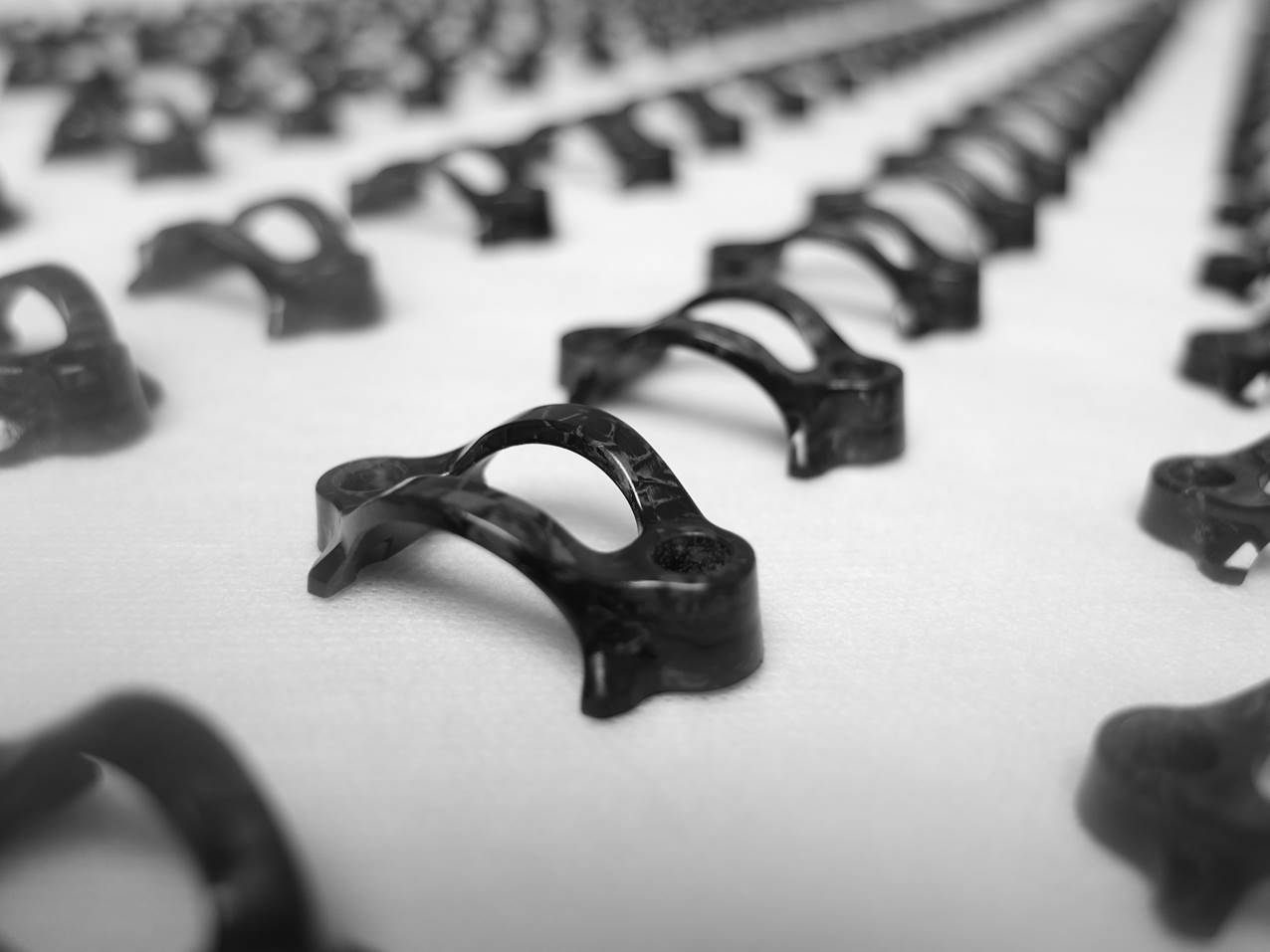
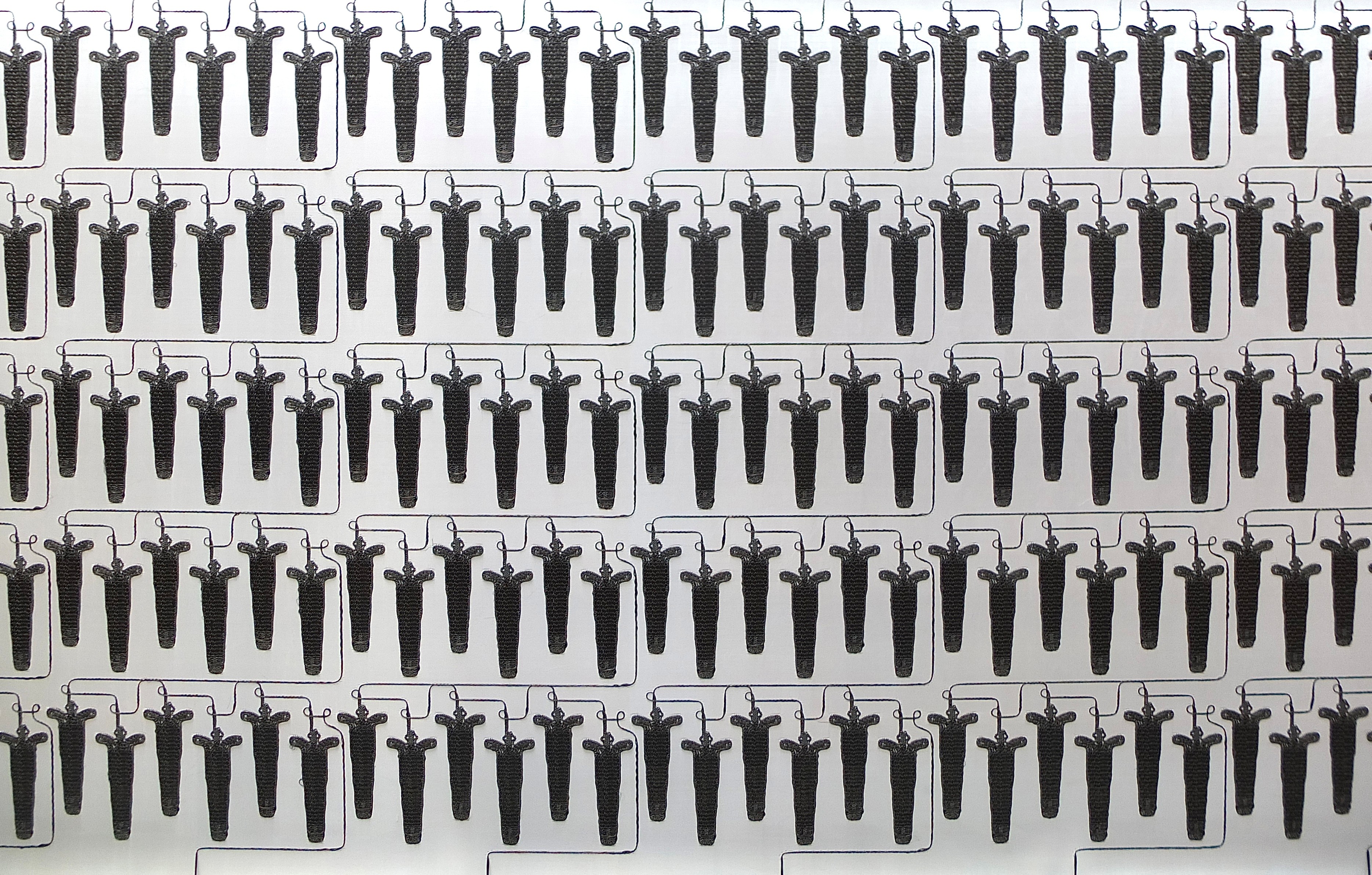
TFP reverses the principle. Instead of cutting fibers out of a fabric, the process places them precisely where they are needed. Tailored Fiber Placement is an automated embroidery process in which technical fibers such as carbon or glass fibers are precisely stitched onto a carrier material using an industrial embroidery machine, computer-controlled along calculated load paths.
This load-path-optimized fiber placement ensures that material is only present where it provides structural support. This pays off especially with complex geometries. Where conventional methods generate a lot of scrap, TFP works almost loss-free. Material waste drops from the usual 30 percent to under 2 percent, which corresponds to a reduction of around 95 percent.
The foundation for this is precise preparatory work. Load paths are calculated via FEM analysis and translated into fiber orientations based on bionic principles before the embroidery machine implements them under computer control. Since multiple layups can be produced in parallel, this high material efficiency is maintained and reproducible even in series production.
The difference between the two approaches is evident in several dimensions:
Less Waste, Stronger Components
The material efficiency of TFP has a second, often underestimated side. Because the fibers are not cut but placed as continuous fibers, their load-bearing capacity is fully preserved. In conventional processes, every cut severs the fibers, and it is precisely at these points that the laminate loses strength. This is particularly critical at holes and cutouts, where conventionally manufactured components are weakened.
With Tailored Fiber Placement, the embroidery is performed specifically around holes and force application points, so that the fiber architecture follows the actual flow of force. This results in components that are stronger, especially at the most highly stressed points, than comparable laminates made from cut fabric. Material savings and component strength are not a contradiction with TFP, but two sides of the same principle.
Added to this is another effect of continuous fiber guidance. Continuous fibers transfer loads over the entire length of the component without interruption, whereas with cut or short fibers, a force drop-off occurs at every fiber end. Fewer cuts therefore mean not only less waste, but also more uniform force transmission within the component.
Sustainability Benefits
Less waste has a direct impact on the environmental footprint. When significantly less material ends up in the trash, resource consumption decreases across the entire production process. Sustainability is thus not created at the end of production, but already in the fiber layout. The key advantages are:
- Lower raw material consumption: Reduced material usage and less scrap
- Lower CO2: Reduced material usage lowers emissions
- Less production waste: Near-zero-waste production
- Resource efficiency: Conserving valuable carbon fibers
- Contribution to ESG goals: Measurable sustainability directly in production
Our guiding principle is simple: the most sustainable fiber is the one that is never wasted in the first place. That is why we apply material precisely where it carries loads, rather than where it would end up as scrap.
This focus on efficiency continues throughout the entire product lifecycle. In combination with thermoplastic matrix systems and consolidation via Hot Compression Molding (HCM) recyclable composite structures can be realized. Thermoplastics can be melted down and reused. With thermoset systems, however, recycling is more challenging because the matrix and fibers are permanently and tightly bonded.
Economic Benefits
At TFP, sustainability and profitability go hand in hand. Since material costs are a significant factor, every fiber saved directly reduces component costs. The environmental benefit is therefore also a business advantage. The key benefits are:
- Lower material costs: Reduced use of expensive fiber material
- Lower disposal costs: Minimal waste requiring disposal
- Higher material utilization: Almost all material goes into the component
- Design-to-cost: Material efficiency is considered during the design phase
- Particularly relevant for carbon fibers: This is where every saving has the greatest impact
The efficiency gained is maintained throughout the entire process chain. The load-path-optimized TFP preforms are subsequently Resin Transfer Molding (RTM) consolidated, a closed process that ensures reproducible quality with minimal use of auxiliary materials.
Technical Advantages Without Compromise
The most important point concerns performance. With TFP, material efficiency does not come at the expense of performance. Because the fibers are placed exactly along the load paths, material is only used where it is structurally necessary. This increases component efficiency while simultaneously reducing weight. The technical advantages are:
- Targeted material usage: Fibers only where they are needed to carry loads
- Higher component efficiency: Optimized strength-to-weight ratio
- Lower component weight: No superfluous material in the laminate
- No conflict of objectives: Sustainability and performance are not mutually exclusive
Moreover, material efficiency does not end with the individual component. Thanks to functional integration, multiple components can be combined into a single part. Ribs, reinforcements, and connection areas are integrated directly into the fiber architecture, eliminating the need for joints and individual parts. This reduces not only assembly effort but also the total material usage of an entire assembly.
This is how fiber-reinforced plastics (FRP)are created that are lighter, more efficient, and more sustainable, without having to compromise on mechanical requirements.
Where Material Efficiency Makes the Biggest Difference
The effect of TFP is most significant where expensive fibers, high production volumes, or complex geometries come together. In such applications, every fiber saved adds up over the production run to create a tangible economic and ecological advantage.
- Aerospace: Weight-critical structures where material value and efficiency are equally important
- Medical technology: Precision components with high requirements for small to medium-sized series
- Mechanical engineering and robotics: Highly dynamic components where every gram affects performance
- Sports and mobility: Lightweight structures where material costs are a direct factor in the calculation
The higher the material value and the larger the series, the more significant the advantage of near-zero-waste manufacturing becomes.
Conclusion: Efficiency That Pays Off Twice Over
Eliminating waste is not a side effect, but the result of a deliberate manufacturing principle. With Tailored Fiber Placement, BIONTEC reduces material waste to less than 2 percent, combining ecological and economic benefits without compromising component performance. Sustainability begins with the fiber layout itself.
Would you like to know how much material you can save on your component? As a carbon composite manufacturer BIONTEC develops solutions that conserve resources and reduce costs. Contact us for a free, no-obligation consultation.