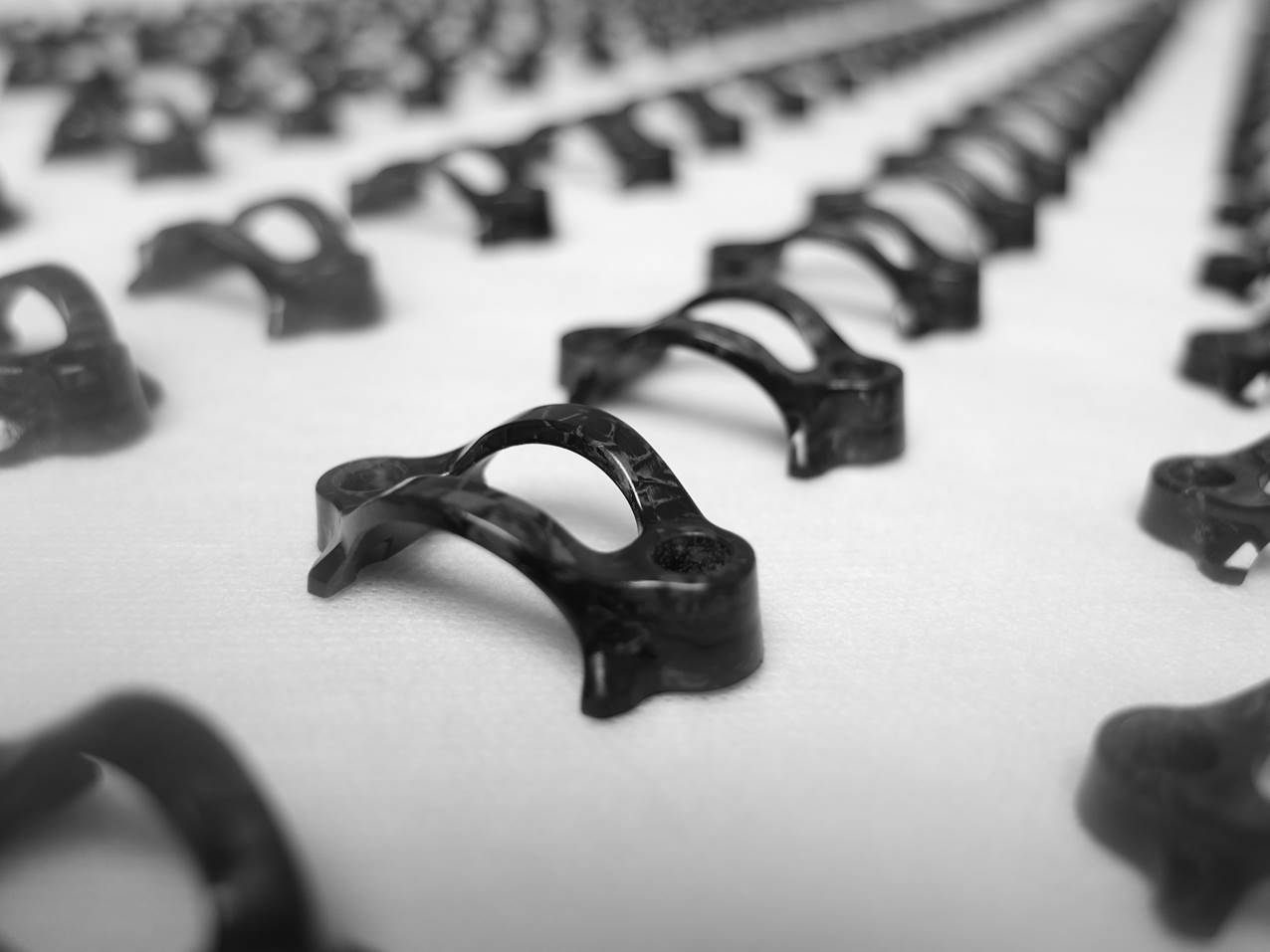
Implants Are Not Ordinary Composite Components
Those who develop composite components for mechanical engineering or aerospace typically prioritize maximum stiffness, minimal mass, and reproducible series quality. Medical implants present a different, significantly more complex set of requirements. In addition to strength and weight, factors such as biocompatibility, long-term behavior under physiological conditions, controlled stiffness profiles, and—depending on the application—the ability to be adapted to individual anatomy intraoperatively are critical.
This is precisely where Tailored Fiber Placement (TFP) opens up possibilities that classic composite manufacturing processes cannot offer.
Where Classic Composite Layups Reach Their Limits With Implants
Conventional fiber-reinforced structures are typically based on unidirectional or multi-layer laminate constructions. Such structures can achieve high strength under pure bending loads. However, as soon as torsion, local load peaks, screw holes, or anatomically adapted transition areas come into play, classic fiber layouts reveal structural weaknesses.
A concrete example: Screw holes and connection points are structurally critical areas in load-bearing fixation systems. In conventionally manufactured laminates, these areas are weakened by subsequent drilling because the fibers are severed. The result is a local loss of strength exactly where the material is under the greatest stress.
Furthermore, there is the issue of contourability. Metallic implants can be adapted to bone geometry intraoperatively. Many classic composite components are geometrically fixed after production, which limits their clinical use in certain indications.
Typical weaknesses of classic composite layups in implants:
- High strength in the main load direction, limited torsional resistance
- Structural weakening due to subsequent drilling of screw and connection holes
- Limited design freedom around geometrically critical areas
- Geometrically fixed after curing, barely adaptable intraoperatively
- Unidirectional reinforcements are prone to delamination and structural failure under complex loads
What Makes Tailored Fiber Placement Technically Interesting for Medical Implants
Tailored Fiber Placement is a textile-based manufacturing process in which continuous fiber rovings are computer-controlled and laid onto a carrier material, then fixed using an embroidery technique. The key feature: fibers are not distributed evenly or across a surface, but are positioned precisely along calculated load paths. Reinforcement is created exactly where it is structurally required.
This results in four technically relevant advantages for medical implants:
1. Load-Path-Optimized Reinforcement
With TFP, fibers can be guided along the main stress directions for both bending and torsion. Especially in fracture fixation systems, where both load cases are relevant simultaneously, Tailored Fiber Placement allows for a more targeted structural design than unidirectional laminates.
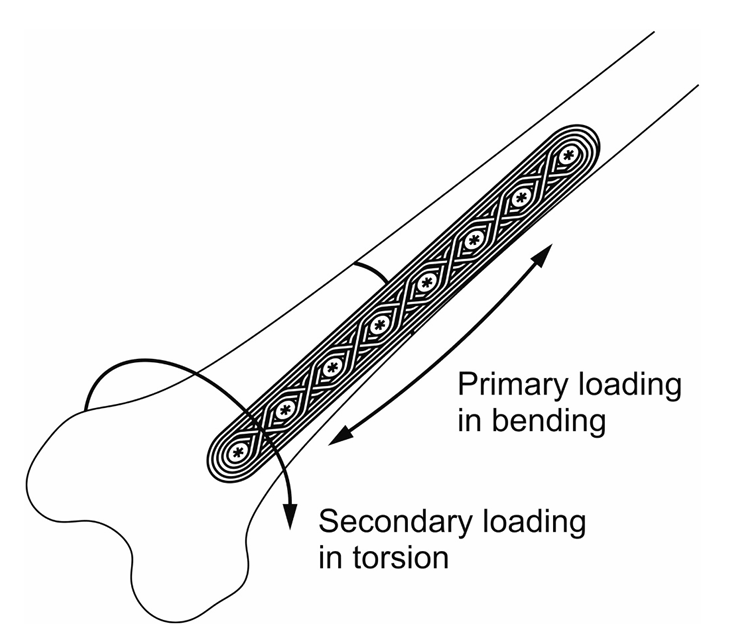
SOURCE: MORITZ ET AL., 2023, FIG. 2
2. Local Reinforcement Without Unnecessary Bulk
TFP places reinforcement only where it is functionally necessary. This supports lightweight and compact implant structures without relying on broad over-dimensioning—a clear advantage when minimal weight and maximum function are required.
3. Functional Design Around Critical Geometries
In implants, cutouts and screw holes are often unavoidable. With Tailored Fiber Placement, fibers can be precisely routed around these zones so that structural integrity is maintained. At the same time, fibers can be effectively distributed under screw heads, leading to more reliable force transmission in the connection area.

SOURCE: MORITZ ET AL., 2023, FIG. 3
4. Controlled Stiffness as an Active Design Parameter
In the field of implants, high strength is not the only requirement. Equally important is a stiffness that matches the specific application to avoid undesirable load redistribution and biomechanically disadvantageous effects. TFP offers significantly more degrees of freedom for this than conventional laminate layups.
BIONTEC in Research: TFP for Load-Bearing Fracture Fixation Systems
The fact that Tailored Fiber Placement works in load-bearing medical implant structures is demonstrated by a study published in Research in Veterinary Science (Moritz et al., 2023), in which BIONTEC participated as a development partner for the design and manufacturing of the TFP preforms. The study examined a novel, intraoperatively contourable composite implant system for the treatment of forearm fractures in small dog breeds. The core of the system: a semi-flexible, TFP-based glass fiber preform that is contoured to the bone and subsequently stiffened by a light-curing resin system, resulting in a load-bearing and geometrically stable fixation system.

SOURCE: MORITZ ET AL., 2023, FIG. 1
Key Findings of the Study
The study provides results that are relevant to implant concepts far beyond individual veterinary cases:
Optimized TFP Fiber Architectures Improve Torsional Performance
The unidirectionally reinforced plates achieved higher flexural strength and stiffness. Under torsional loading, however, the optimized TFP designs performed better. The results demonstrate how TFP enables fiber architectures to be tailored to different loading conditions.
Optimized TFP Designs Exhibit More Cohesive Failure Behavior
In addition to improved torsional performance, the optimized TFP designs exhibited more cohesive failure behavior. While the unidirectionally reinforced plates tended to crack and break into several pieces under load, the TFP-based structures remained more intact. This behavior can be particularly advantageous under complex loading conditions.

SOURCE: MORITZ ET AL., 2023, FIG. 12
TFP vs. Classic Laminate: What Makes the Difference?
Which Fibers Are Suitable for Medical Implants?
When it comes to medical implants, material selection is not just a question of performance. Biocompatibility, long-term behavior, regulatory compliance, and clinical objectives play an equally important role. In principle, several classes of fibers can be distinguished that are suitable for use in TFP-based implant structures.
Glass Fibers
Glass fibers are well-established in the context of implants. They offer a balanced ratio of mechanical performance, processability, and medical suitability; they are electrically non-conductive, easy to process as textile semi-finished products, and can be used in both biostable and bioresorbable matrix systems. E-glass fibers were also used as the reinforcement component in the cited study.
Bioactive Glass Fibers
Bioactive glass fibers are a promising approach for bioresorbable or regenerative implant concepts. They combine structural function with biological interaction—a profile that is highly attractive for temporary or bioresorbable support structures and is receiving increasing attention in research.
Polymer-Based Hybrid Yarns
Hybrid yarns made from polymers and reinforcing fibers allow for the integration of reinforcement and matrix components directly into the textile semi-finished product. This is particularly attractive for thermoplastic or bioresorbable TFP preforms.
Note on material selection: Not every high-performance fiber from the industrial composites sector is automatically suitable for medical implants. Carbon fibers, for example, are an excellent choice for prostheses, orthoses, and radiolucent medical devices because their low radiopacity is a clear advantage in those applications. However, for long-term implanted, load-bearing fixation systems, other criteria play a decisive role, including electrical conductivity, wear behavior, imaging properties, and regulatory requirements.
Matrix: Thermoplastic or Thermoset Systems?
The choice of matrix system influences not only processability but also contourability, sterilizability, long-term performance, and the potential spectrum of clinical applications. Both system classes are suitable for TFP-based implant structures, each with distinct strengths.
Thermoplastic Matrix Systems
Thermoplastics soften when heated, allowing them to be reshaped or consolidated. They are particularly interesting for bioresorbable implant concepts, such as those based on PLA or similar polymers.
Advantages:
- Good formability and post-formability
- Potentially better damage tolerance compared to thermosets
- Interesting for bioresorbable concepts, such as those based on PLA
- No classic curing step required
Thermoset Matrix Systems
Thermosets cure chemically to form an irreversible network. They are compelling when precise mechanical properties, good preform impregnation, and high dimensional stability are required. Light-curing resin systems offer a particularly interesting concept: the preform remains flexible, is adapted to the anatomy intraoperatively, and is then stiffened via light curing.
Advantages:
- Good impregnation of textile preforms with low-viscosity resin systems
- High dimensional stability and defined mechanical properties after curing
- Light-curing systems enable intraoperative adaptability and subsequent stiffening in a single step
- Suitable for precise, load-bearing composite structures
The right choice depends on whether the implant is intended for permanent or temporary use, whether intraoperative adjustability is required, and whether the goal is to develop a bioresorbable or biostable system.
Outlook: Medical Implants Beyond Individual Cases
The implant concepts examined in the study are technologically transferable to a broader range of applications. The authors explicitly mention further potential applications in veterinary and human medicine, including other fracture fixation systems and the maxillofacial area.
Wherever implants need to be designed to be precise, load-optimized, lightweight, and geometrically complex, interesting application areas emerge for TFP-based fiber architectures. The performance of medical composite implants does not depend on the material alone: fiber architecture, fiber volume content, and the interaction between fiber and matrix are equally decisive.
Conclusion: Fiber Architecture as Implant Design
Tailored Fiber Placement opens up a development space for medical implants that traditional manufacturing processes cannot offer. Instead of applying reinforcement in flat layers, fibers can be positioned functionally along actual load paths, specifically around critical geometries, with a controllable stiffness profile and maintained structural integrity even under complex loading conditions.
The published study on TFP-based fracture fixation systems, in which BIONTEC participated as a development partner and manufacturer of the TFP preforms, is a visible example of how this approach can be applied in a demanding medical technology context.
Source: Moritz, N., Liesmäki, O., Plyusnin, A., Keränen, P., & Kulkova, J. (2023). Load-bearing composite fracture-fixation devices with tailored fibre placement for toy-breed dogs. Research in Veterinary Science, 156, 66–80. https://doi.org/10.1016/j.rvsc.2023.02.001
Do you have a medical device component that could benefit from a load-path-optimized TFP fiber architecture? Contact us for a free, no-obligation consultation.