
CFRP vs. Aluminum: Where carbon really wins
Two materials, one design question
CFRP is superior to aluminum primarily when a component requires high stiffness, dimensional stability during temperature changes, or low vibration at a low weight. Whether these advantages come into play depends on the design. Only by specifically orienting carbon fibers can the properties be tuned to the actual load. If aluminum already performs the task economically, it remains the right choice.
Aluminum is a lightweight metal, easy to machine, and found in countless technical components. CFRP, or carbon fiber reinforced plastic, combines carbon fibers with a matrix system: the fibers provide high stiffness and strength, while the matrix system holds them together and transfers forces between them.
The magnitude of this effect in series production is demonstrated by the brake clamp that BIONTEC manufactures for Magura. It weighs about 61 percent less than the aluminum part it replaces.
Isotropic or anisotropic? The fundamental difference
When calculating its stiffness, aluminum is treated as approximately isotropic. Its mechanical properties are similar in all directions, regardless of the direction from which the load is applied. CFRP behaves anisotropically: stiffness and strength depend on the direction in which the fibers run.
What sounds like a limitation at first is actually the primary advantage of carbon fiber reinforced plastics. Because the properties are direction-dependent, the fibers can be specifically aligned to the actual load. An isotropic material provides the same material properties in every direction, regardless of whether they are needed there. An anisotropic material can be designed to be strongest where the load actually acts, provided the fibers are laid accordingly.
Four advantages of CFRP over aluminum
Depending on the application and design, CFRP offers several advantages over aluminum. Which of these come into play depends on the load case and the component's operating environment.
- Lower weight: A lighter component requires less force to accelerate and decelerate. This reduces the load on drives and shortens movement cycles.
- High stiffness at low weight: The component remains lightweight while deforming very little under load. For long booms and wide support structures, this ratio is exactly what counts.
- Lower thermal expansion: The shape can remain more stable during temperature changes, provided the fiber architecture is designed for it. For measuring instruments where geometric deviations lead directly to measurement errors, this is one of the strongest arguments for switching materials.
- Good vibration damping: Vibrations can decay more quickly. The strength of this effect depends on the fiber arrangement and the design of the component. Precise movements and measurements benefit from this because the component comes to rest more quickly after a movement.
The following overview summarizes the differences that most frequently prove decisive in practice:
Why not all CFRP is the same
The properties of a carbon composite component depend on the choice of fibers, their arrangement, and the manufacturing process. Therefore, strictly speaking, comparing CFRP to aluminum in general terms is comparing a specific design to a raw material.
Often, cut fiber layers are stacked and oriented at different angles. Another approach involves placing the fibers specifically along the load paths within the component. This is exactly where BIONTEC uses Tailored Fiber Placement.
Tailored Fiber Placement: Fibers follow the forces
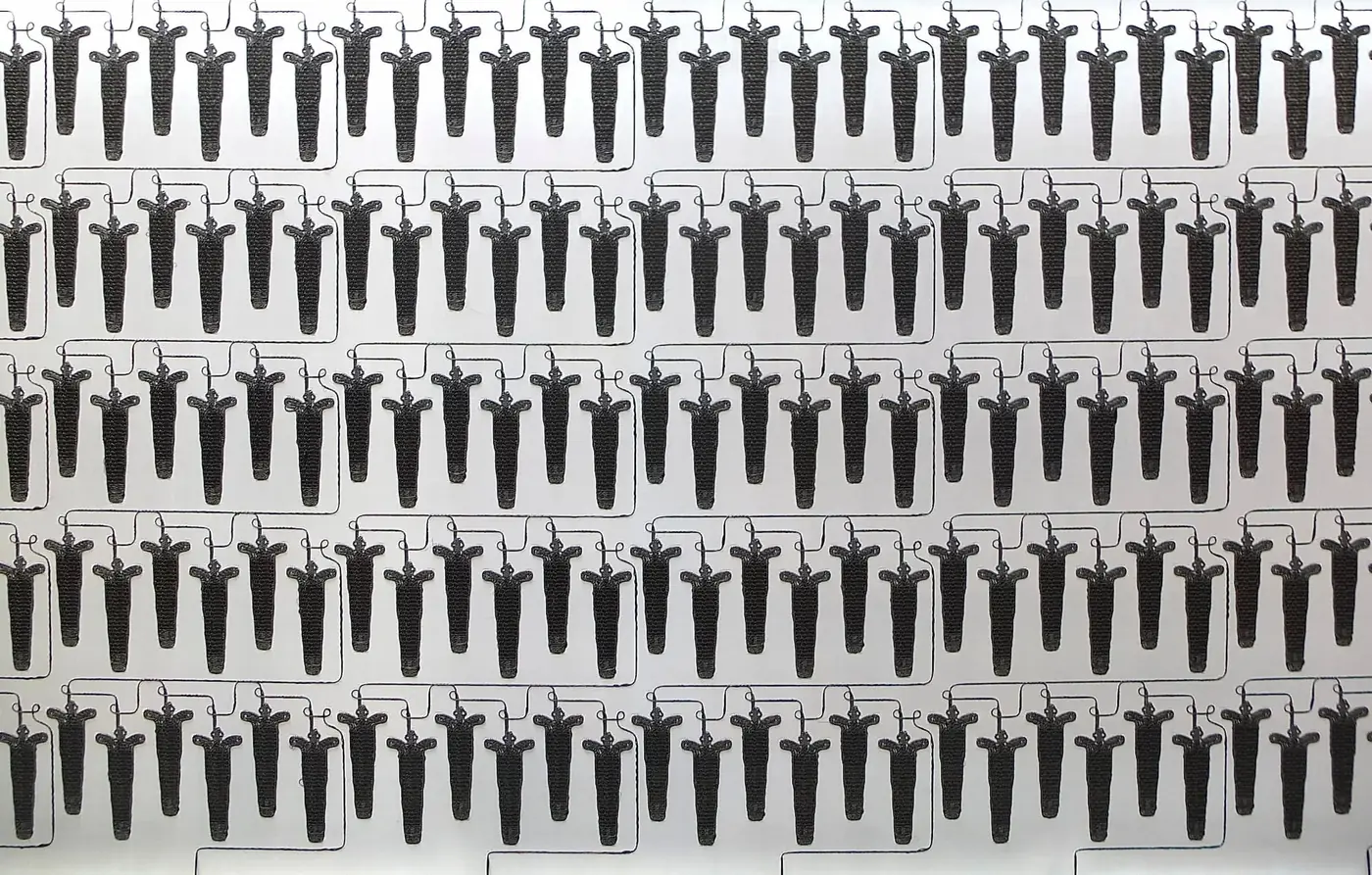
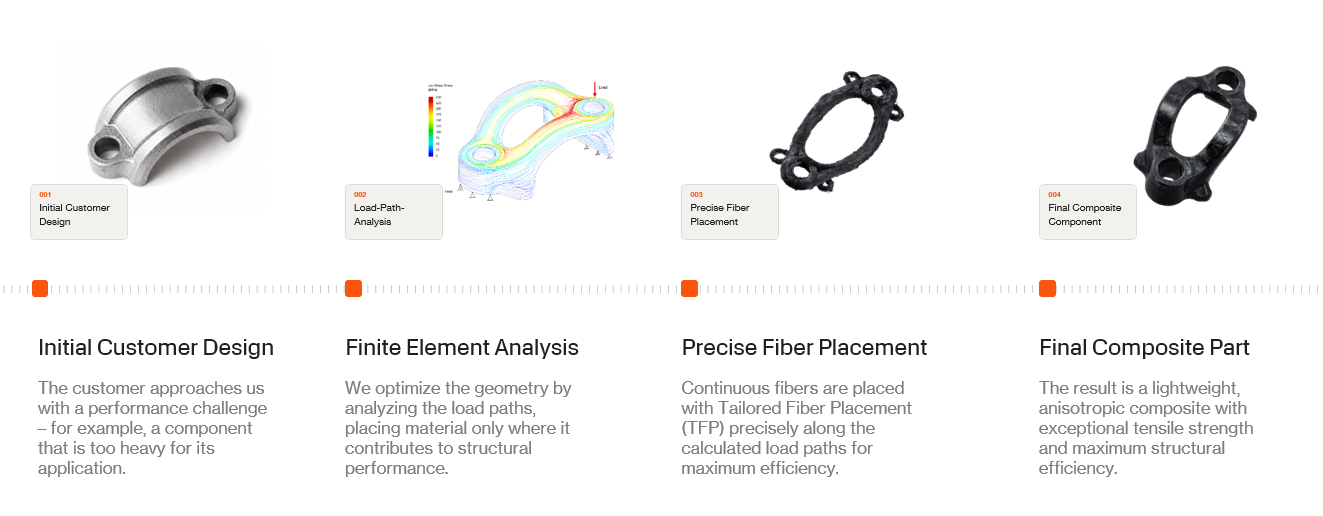
BIONTEC first calculates where and in which direction forces act within the component. With Tailored Fiber Placement (TFP), fiber bundles are then computer-controlled and fixed onto the carrier material through an embroidery process. This creates a textile preform that already contains the fiber architecture of the final component.
- Fibers along the load path: Curved fiber paths are also possible.
- Targeted reinforcement: Highly stressed areas receive additional fibers.
- Less waste: The preform is created close to the required final shape.
- Repeatable production: Digital placement data allows the same fiber arrangement to be produced repeatedly with high precision.
A simple example is a mounting hole. Instead of drilling through the fibers later, TFP guides the fiber paths around the intended opening. The fibers remain continuous, and the stressed area around the opening can be specifically reinforced.
RTM and HCM: From preform to finished component
In Resin Transfer Molding (RTM), the preform is impregnated with resin in a closed mold and cured. For thermoplastic matrix systems, BIONTEC also relies on Hot Compression Molding (HCM), which involves shaping under heat and pressure. Both processes translate the load-path-optimized preform into a reproducible series-production component.
Practical example: Magura brake clamp in CFRP instead of aluminum
A prime example of BIONTEC's series production is the clamp used to attach a Magura brake to the handlebars. The component was converted from aluminum to CFRP. The aluminum clamp weighs 4.60 grams, while the TFP carbon composite clamp weighs 1.81 grams. This represents a weight reduction of around 61 percent while maintaining high rigidity.
- Component: Magura brake handlebar clamp
- Material change: Aluminum to CFRP, manufactured as a TFP preform
- Weight: 4.60 g (aluminum) versus 1.81 g (CFRP), around 61 percent lighter
- Fiber architecture: Load-path-optimized preform, fiber placement around the clamping holes for high load transfer, very tight radii
- Production volume: Series production in very high volumes
The clamp illustrates what is essential when switching materials. The fibers run around the holes instead of through them, the finest structures and tight radii are already incorporated into the preform, and the high production volume justifies the design effort.
Five use cases: Where CFRP replaces aluminum
Replacing an aluminum component with a suitably designed CFRP part is particularly worthwhile in the following situations.
- Faster machine movements: For grippers, robotic arms, or pick-and-place applications, a lighter carbon structure enables higher acceleration and reduces the load on the drives. In robotics every gram of moving mass counts.
- Precision during temperature fluctuations: For sensor mounts and measuring frames, a carbon composite structure with low thermal expansion stabilizes the geometry and reduces temperature-related measurement deviations. For metrology applications, this is often the most important argument for making the switch.
- More payload or longer flight time: For drones, a lighter CFRP structure creates additional payload capacity at the same total weight or longer flight times with the same payload.
- Long and lightweight booms: For long machine arms or wide support structures, CFRP combines high flexural rigidity with low dead weight. This allows deflection to be limited without making the structure heavier.
- Less vibration: For precise positioning and measuring tasks, an appropriate fiber layout reduces vibrations. The component reaches a stable position faster, allowing the next work step to begin sooner.
When aluminum remains the better choice
Aluminum remains the right choice if it already fulfills the task economically. This is often the case when the component does not have to meet special requirements regarding weight, rigidity, dimensional stability, or vibration behavior. The material is easy to machine, and for simple components, the effort of a targeted fiber layout is unnecessary.
CFRP requires this effort in every case: load paths must be calculated, fibers laid out, and a suitable manufacturing process selected. This pays off when the requirements for the component are high and the production volume justifies the design effort. The decision is therefore based on the requirements, the production volume, and the total cost of the finished component.
Conclusion: When CFRP is worth it
Switching from aluminum to CFRP is worthwhile as soon as the material properties limit the overall system. Carbon fiber reinforced plastics win out wherever weight, rigidity, dimensional stability during temperature changes, or vibration behavior determine performance.
The deciding factor is less the material itself than the design. Only when the fibers follow the forces does CFRP fully demonstrate its strengths over aluminum, as evidenced by the Magura clamp weighing 1.81 grams instead of 4.60 grams. BIONTEC will work with you to determine whether your aluminum component is suitable for conversion into fiber-reinforced plastics is suitable. Design and engineering take place at our headquarters in St. Gallen, while series production is carried out at our facilities in Switzerland, Romania, and China.
Do you have an aluminum component that needs to be lighter, stiffer, or more dimensionally stable? As a carbon composite manufacturer, BIONTEC designs it using TFP and RTM to ensure optimal load path alignment. Contact us for a free, no-obligation consultation.